


Retail investors spend a lot of time hunting for the next big story: the next AI winner, the next turnaround, the next ten-bagger. But plenty of medium-term stock moves do not come from new narratives at all. They come from old problems finally being forced into the open: bloated portfolios, weak boards, bad capital allocation, under-earning assets, or management teams that have had too much room to drift. That is where activist campaigns matter. The right way to use them is not as blind copy trades, but as a high-quality screen for governance change the market may still be underpricing.

Elliott is a useful anchor for this idea because it does not just buy “cheap” stocks. It tends to show up where there is a specific gap between what a company is and what it could look like under tighter capital discipline, cleaner structure, or more accountable oversight. That is why Elliott’s campaigns often feel less like speculative predictions and more like pressure applied to already-visible inefficiencies. The lesson for retail investors is not “buy whatever Elliott buys.” The lesson is “study why this company became targetable in the first place.”
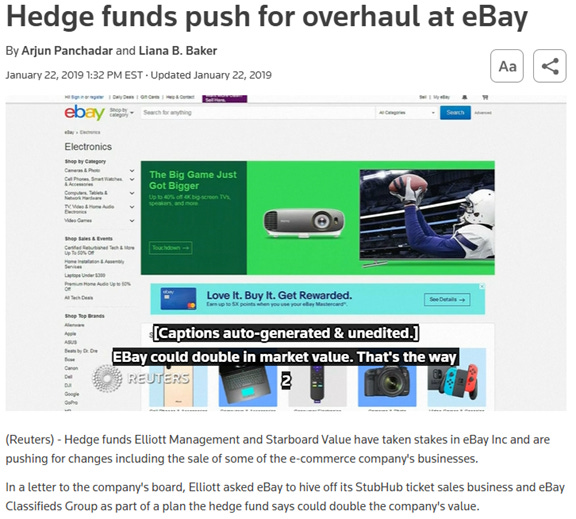
The cleanest case study is eBay. In January 2019, Reuters reported that Elliott had built a stake of more than 4% and publicly pushed eBay to separate StubHub and Classifieds, arguing the stock could reach $55 to $63 by 2020 if the company restructured. The stock immediately reacted, rising as much as 12% and trading up 5.7% to $32.78, after having lost roughly a quarter of its value the year before. That first jump matters because it shows the market understood the thesis right away: portfolio simplification, asset monetization, and governance pressure were suddenly on the table.
What made eBay so instructive was not the initial pop but the sequence that followed. By March 2019, eBay had announced a strategic review of StubHub and Classifieds and said it would appoint two independent directors. In November 2019, it sold StubHub for $4.05 billion. By September 2020, Reuters reported that eBay had sold both StubHub and Classifieds, installed a new CEO, introduced its first dividend, and expanded margins. The stock closed at $52.32 that day, versus $28.97 before Elliott’s position became public, and had reached $59.27 in July 2020. In other words, the campaign moved from public thesis, to board and strategic concessions, to hard operating and capital-return outcomes, and then to a materially higher stock price.
That pattern shows up in other Elliott campaigns too, even when the playbook changes. At Salesforce, Reuters reported Elliott’s multibillion-dollar investment in January 2023. By March, Salesforce had doubled its buyback authorization to $20 billion. By late November, the stock had climbed about 87% year to date, helped by stronger margins and a broader reset around spending discipline. This was not a breakup story like eBay. It was a margin, capital-return, and governance-discipline story. The key takeaway is that activist value can come from forcing operational accountability, not just asset sales.
Suncor was another version. In April 2022, Elliott pushed for a strategic review, board refresh, and management overhaul, arguing the company had lagged even as crude prices surged. Reuters later reported that Suncor’s stock had risen 56% since Elliott’s campaign began. That does not mean activists “caused” all of the return; energy prices clearly helped. But it does show why retail investors should watch for campaigns where a company is underperforming even inside a favorable industry backdrop. When that happens, governance can become the cleanest explanation for the discount.
Phillips 66 offered a similar but faster-moving template. In November 2023, Elliott disclosed a $1 billion stake and argued the stock, then around $118, could reach $200 with better execution and board oversight. By February 2024, Phillips 66 had added energy veteran Robert Pease to the board and agreed to work with Elliott on a second director. By late March, Reuters reported the shares had climbed 32% to $156.37 since Elliott publicly disclosed its recommendations. Again, the point is not that the filing itself was the edge. The point is that the company moved from “constructive dialogue” to concrete governance concessions and operational targets the market could actually track.
SoftBank shows a different kind of activist setup: discount-to-holdings and capital structure. Reuters reported in March 2020 that SoftBank announced a buyback of up to $4.8 billion after pressure from Elliott. Ten days later, it unveiled a plan to raise as much as $41 billion through asset sales to fund buybacks and reduce debt, and the stock jumped 19% in its biggest daily gain in nearly 12 years. This is important because not every activist campaign is about fixing an operating company. Sometimes the opportunity is simply that a complex holding company is trading at too wide a discount and needs balance-sheet action to close that gap.
But this is exactly why activist campaigns are not copy trades. Western Digital is the necessary cautionary example. In May 2022, Elliott pushed Western Digital to split its flash and HDD businesses, and the shares rose nearly 12% to $60.12 in early trading. A month later, the company said it was reviewing strategic alternatives, including a split. In October 2023, Western Digital finally announced that separation, and the shares closed at $41.80 that day. The strategic outcome Elliott wanted largely happened, yet the stock path was messy and negative over that window because industry conditions and timing mattered. A correct thesis does not guarantee a clean return path for outside investors.
That is the real conclusion for retail investors: Activist campaigns are useful not because they tell you what to buy on day one, but because they tell you where to look harder. They narrow the universe to companies where governance frictions, capital allocation mistakes, or structural complexity may still be suppressing value. Used properly, they are a research filter for mispriced governance change.
What retail investors should actually watch:
When the thesis becomes public. eBay’s January 2019 letter made the restructuring logic legible immediately; the first job is to understand the activist’s map of trapped value, not chase the first price spike.
When management moves from words to concessions. eBay’s strategic review, Phillips 66’s board addition, and Western Digital’s “reviewing alternatives” stage were more important than the initial headlines.
When assets, board changes, and capital return start lining up. eBay’s asset sales plus dividend plus CEO change, Salesforce’s buyback expansion, and SoftBank’s buyback-plus-asset-sale plan all gave the market something tangible to reprice.
Whether the company is underperforming peers for fixable reasons. Suncor and Phillips 66 were both framed as laggards inside industries that were otherwise doing well, which made governance and execution the obvious pressure points.
What the confounders are. Salesforce also benefited from a broader tech rerating; Suncor had commodity support; Western Digital shows that even a “successful” strategic campaign can still produce an ugly holding period.
The edge, then, is not copying Elliott’s entry price. It is learning to recognize when a governance discount has become visible, when pressure is turning into action, and when the market still has not fully connected the dots. For retail investors, that means using activist campaigns less as trade alerts and more as a filter for live rerating setups.
The table below is where this thesis becomes actionable. It is a screened list of live
