


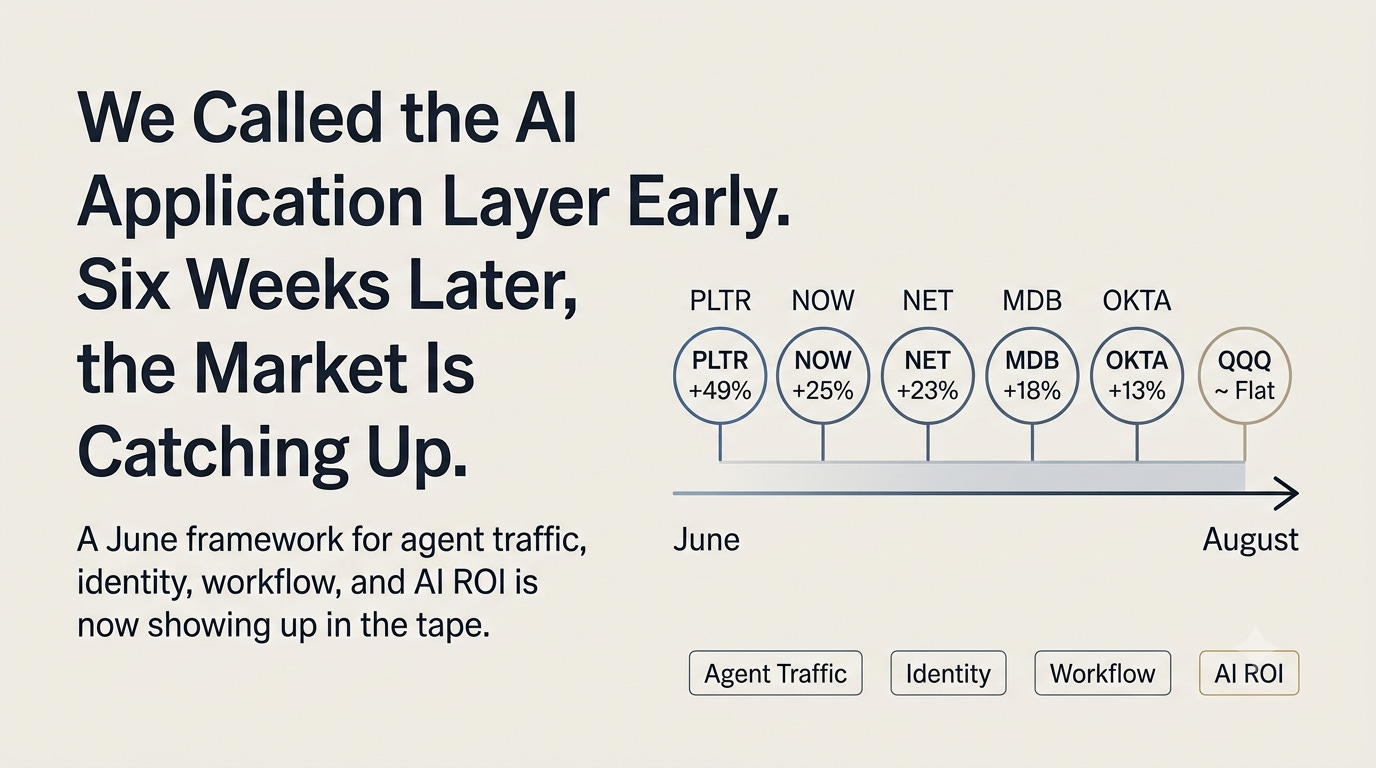
In June, we published a DeepDive article arguing that the next AI opportunity would not only come from chips, data centers, or cloud capacity. It would also come from the application layer – the companies sitting where agentic AI creates new traffic, new identities, new workflows, new cost structures, and new ROI pressure.
Six weeks later, that framework is starting to show up in the tape.
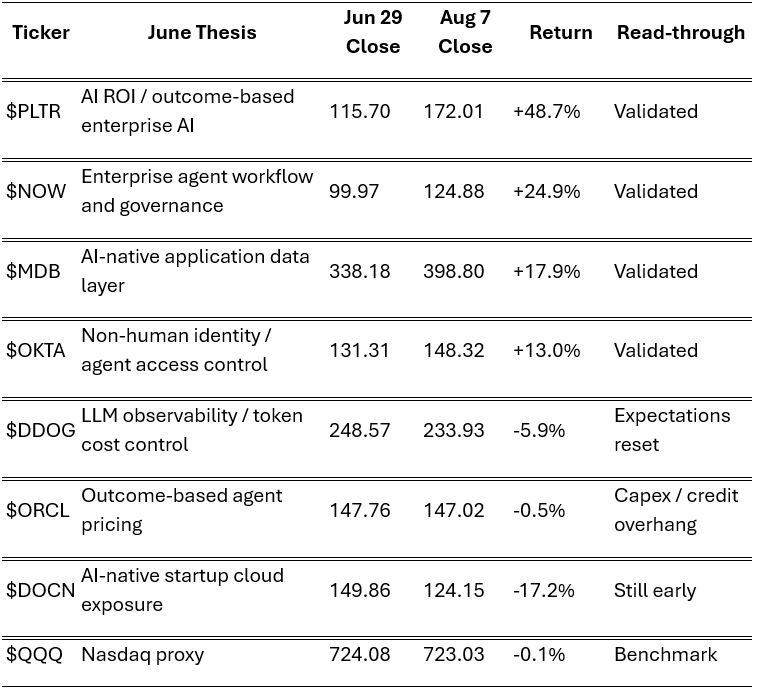
From the first trading day after publication through August 7, several of the companies tied to our June thesis significantly outperformed the Nasdaq proxy.
A human might visit five websites to compare a product. An AI agent can visit thousands of websites, call APIs, query databases, authenticate across systems, trigger workflows, and return one synthesized answer. The user intent may be the same, but the computational path becomes much heavier.
That means more traffic, more tokens, more cloud usage, more identity checks, more observability, and more pressure to prove whether the AI work actually produced a business outcome.
This is not a victory lap around every single name. That would be the wrong lesson.
The real point is that the framework worked.
This review is free for all readers. Our paid PickAlpha Deep Dives will continue to track these themes in greater depth — including which names still have forward alpha, which ones look priced in, and where the next AI application-layer opportunities may emerge. Subscribe to follow our ongoing research.
The strongest performers were not random AI software names. They were the companies most directly tied to the control points we highlighted in June: agent traffic, enterprise governance, measurable AI ROI, and AI-native application infrastructure.
1. Agent-facing internet: Cloudflare became the cleanest proof point
Our first June theme was the rise of the agent-facing internet.
In a human-led internet, security and traffic management were built around browsers, users, websites, and applications. In an agent-led internet, the edge of the web has to answer a different set of questions:
Who is this agent acting for?
Should it be allowed to access this page, API, or database?
Can it transact?
Can the merchant trust it?
Can the enterprise govern it?
That is why Cloudflare was one of the clearest names in the original framework. It sits close to the traffic layer, where machine-to-machine interactions, bot behavior, API calls, and access control all become more important.
The market has started to recognize that. Cloudflare’s stock rose more than 23% from the first trading day after our June article through August 7.
More importantly, the company’s own product direction moved directly into the agentic internet thesis. Cloudflare has now introduced tools designed to give AI agents an identity and a wallet, allowing businesses to understand who is behind an agent and allowing agents to pay safely on behalf of users.
That is almost exactly the control-point thesis we laid out in June.
2. Enterprise agent governance: Okta and ServiceNow moved into the right narrative
Our second theme was enterprise agent governance.
If AI agents become part of the workforce, enterprises will need to manage them like a new class of non-human worker. Every agent needs identity, permissions, policy, monitoring, auditability, and lifecycle management.
That pointed us toward Okta and ServiceNow.
Okta’s core business is identity. In the AI era, identity does not stop with employees and customers. It extends to service accounts, bots, tokens, and AI agents. This is why non-human identity is becoming one of the most important security categories inside enterprise software.
ServiceNow’s position is different but complementary. It is not only about identity. It is about workflow. If agents are executing tasks across HR, IT, finance, customer service, and operations, the enterprise needs a control layer that can observe, govern, secure, and measure what those agents are doing.
Since our June article, both stocks have performed well. $OKTA rose roughly 13%, while $NOW rose nearly 25%.
The market is beginning to understand that agentic AI is not only a productivity feature. It is a governance problem.
3. AI ROI: Palantir became the cleanest expression of the shift
Our third theme was the shift from AI usage to AI ROI.
This may be the most important software thesis of the next phase.
The first stage of enterprise AI was experimentation. Companies tested copilots, added AI features, bought tools, and tolerated cost inflation because no one wanted to fall behind.
That stage is ending.
Enterprises are now asking a harder question: what did the AI actually produce?
That is where Palantir stood out in our June framework. The company’s pitch is not simply “we have AI.” It is that its software can tie AI deployment to operating outcomes: better workflows, better decision systems, better logistics, better production planning, and measurable business impact.
Since our June article, $PLTR has risen almost 49%, making it the strongest performer in the group.
The tape is now rewarding what we thought mattered: not AI activity, but AI outcomes.
4. AI-native customers: MongoDB was the better public-market expression
Our fourth theme was the rise of AI-native customers.
Beyond the large model labs, there is a growing universe of AI-native startups and software companies that need databases, observability, security, developer tools, and cloud infrastructure from day one. Many of the purest beneficiaries remain private, but public-market investors can still find second-order exposures.
MongoDB was one of the cleaner examples in our June article. AI-native applications often need flexible data structures and developer-friendly infrastructure. That makes MongoDB a reasonable public-market proxy for the application data layer behind AI-native software.
$MDB rose nearly 18% during the review period, outperforming the Nasdaq proxy and validating the idea that AI-native application growth can create second-order software winners.
DigitalOcean, another name we mentioned, has not yet worked in the tape. That is an important reminder: smaller-cap AI infrastructure exposure can be volatile, and not every logical beneficiary becomes an immediate market winner.
What did not work as cleanly
A serious research process should also ask what did not work.
Datadog is the most interesting case.
The company still fits the AI observability thesis. Enterprises need to know where token costs, latency, model calls, and AI workflow errors come from. That makes observability a natural control point in the AI application layer.
But the stock was reset after earnings. The issue was not that observability stopped mattering. It was that expectations had become very high, and the market became more sensitive to usage patterns and the sustainability of AI-native customer demand.
That is a useful lesson for the next phase: AI-native customer exposure cuts both ways. It can accelerate growth, but it can also introduce concentration risk and usage volatility.
Oracle is another mixed case. The company remains relevant to the pricing-model shift, especially as enterprise software experiments with outcome-based AI agent pricing. But the stock has been held back by a separate concern: balance-sheet risk, credit sensitivity, and the cost of funding heavy AI infrastructure buildouts.
In other words, the theme was right, but the equity story was complicated by capital intensity.
The forward view: the application layer still matters
The June framework was not about buying every software company with an AI slide. That is still the wrong approach.
The application-layer opportunity is more specific.
We continue to think the best hunting ground is where agentic AI creates a new control point:
Agent-facing internet and machine traffic
Non-human identity and AI security
Enterprise workflow governance
AI observability and cost control
Outcome-based AI software
AI-native application infrastructure
The original group still contains several names worth tracking, especially $NET, $OKTA, $NOW, $PLTR, $MDB, and $DDOG.
But the framework can also be extended.
In security, we would expand the watchlist to companies like $CRWD and $ZS, where agentic AI creates new problems around continuous identity, zero trust, endpoint AI risk, browser-layer controls, and real-time governance.
In workflow software, $TEAM deserves more attention after its recent results. If AI lowers the cost of software creation, it may not destroy collaboration and developer workflow tools. It may expand the number of people building, coordinating, documenting, and deploying software. That is a different answer from the simple “AI kills SaaS” narrative.
In data and observability, the next question is which companies become the system of record for AI activity. Enterprises will need to track prompts, tokens, model calls, agents, workflows, costs, errors, and outcomes. That keeps the broader observability and data infrastructure category relevant.
The broader market is still obsessed with the infrastructure layer. That trade is not over. GPUs, networking, data centers, power, and cloud capacity remain central to the AI cycle.
But the next layer of alpha may come from asking a different question:
Once the infrastructure exists, who governs the work?
That was the core of our June research. Six weeks later, the tape is starting to catch up.